
August 7, 2026
Protecting Your Back While Lifting Patients: Essential Tips for Healthcare Workers
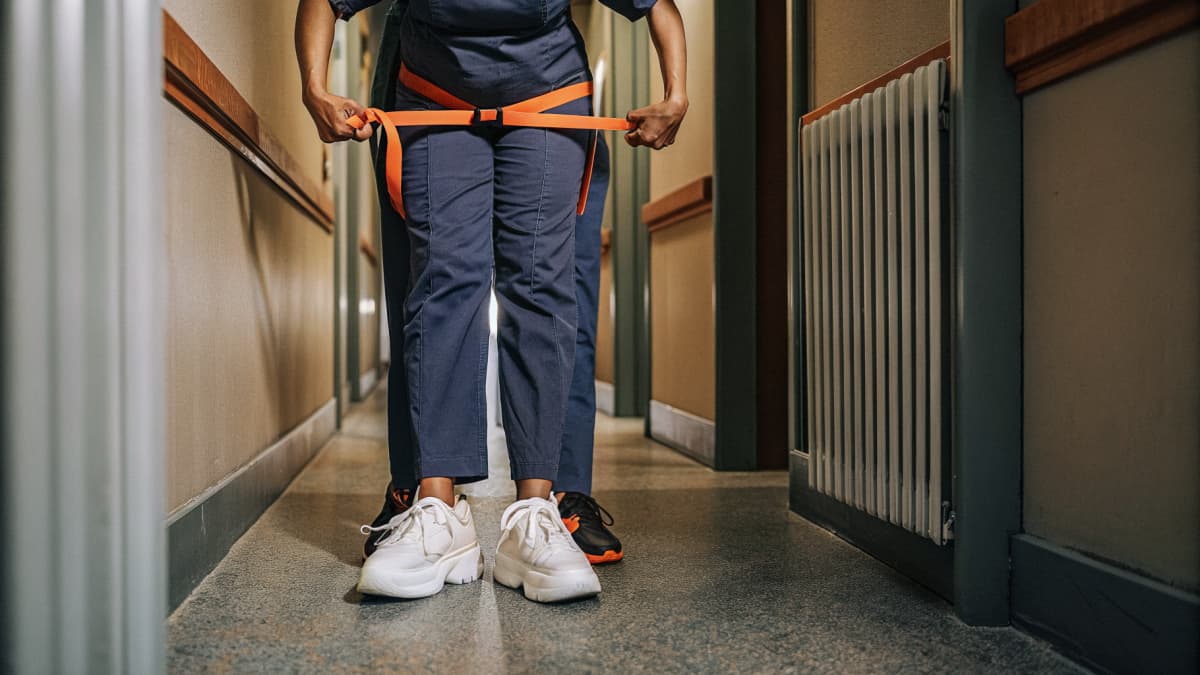
"My lower back is dead by the end of one shift." You've said it, heard it, or lived it. What most people don't realize is that the damage rarely happens during the lift itself. It happens in the two seconds before it, when you're rushed, the patient is already half out of the bed, and you grab and go instead of setting up right. Bedside RNs and CNAs move more dead weight in a single shift than most warehouse workers move in a week, except nobody hands you a forklift. You get your own two hands, a gait belt if you're lucky enough to find one, and whatever technique actually stuck from orientation. Protecting your back isn't about being strong enough to power through a bad lift. It's about never putting yourself in a bad lift in the first place.
The Lift Everyone Learns and Almost Nobody Does Right
Bend the knees, not the back. You heard it your first week of clinicals and you'll hear it your last week before retirement, because it's true and because it's the first thing that gets skipped when you're short-staffed and the call light's been on for ten minutes. The mechanics are simple: feet shoulder-width apart, squat down to the level of the load instead of hinging forward at the waist, keep the patient as close to your body as the situation allows, and drive up through your legs, not your spine. Twisting is the other silent killer. Rotating your torso while your feet stay planted loads the spine at an angle it was never built to hold, so pivot your whole body with your feet instead of turning at the waist.
None of this is new information. What's new is admitting that knowing the technique and using it under pressure are two different skills, and the second one only gets built by slowing down on purpose, every single time, even when the unit is slammed.
Gait Belts and Slide Sheets Aren't Optional Extras
A gait belt gives you a real handle instead of grabbing under the arms or pulling on a limb, and it puts the load closer to your center of gravity where your legs can actually handle it. Slide sheets do the same job for repositioning, turning a drag that grinds on your lumbar spine into a controlled glide that takes most of the friction out of the movement. If your unit has them and they're sitting in a supply closet instead of in your hands, that's the gap. Ask where they're kept, keep one in your pocket at the start of shift, and use it on the first transfer instead of the third one after your back's already complaining.
When It's a Two-Person Job, Make It a Two-Person Job
Every unit has an unspoken rule about how many people you're supposed to call before a lift, and every unit has nurses who quietly break it because asking for help feels like admitting you can't keep up. Flip that. Calling for a second set of hands on a full-assist transfer isn't falling behind, it's the move that keeps you working next year instead of on light duty. If your facility has a mechanical lift or a sit-to-stand device, that's not a last resort for the heaviest patients, it's the first option for any transfer where the patient can't bear meaningful weight on their own. The five minutes it takes to grab the lift is nothing compared to the months a herniated disc takes out of your career.
Your Shoes Are Doing More for Your Spine Than You Think
Nobody talks about footwear as back protection, but a stable base changes everything about how a lift loads your spine. A shoe with real grip keeps your feet planted through a pivot instead of sliding mid-lift, which is exactly the moment a twisted spine turns into a strained one. A worn-out sole with no traction left is doing the opposite of protecting you, no matter how good your form is. Sneakers and socks are also the one piece of gear the dress code can't touch, so the pair that's actually holding your stance together on the floor can be the same pair you're proud to wear off shift too. If you've got a grail pair that keeps your footing solid on shift, we'll match a shirt, hoodie, or socks to that exact colorway so the fit that protects your back on the clock looks just as good the second you clock out.
The Damage That Doesn't Show Up Until Later
A strained back from one bad transfer usually heals. What doesn't heal as easily is the version of this that builds quietly over years, disc by disc, from hundreds of rushed lifts that each seemed fine on their own. That's the real reason technique, tools, and footwear matter more than raw strength ever will. Your body isn't just getting you through today's twelve hours, it's the only one you'll have for every shift after this one. Protecting it isn't extra caution, it's the difference between a full career at the bedside and an early exit you didn't choose.